
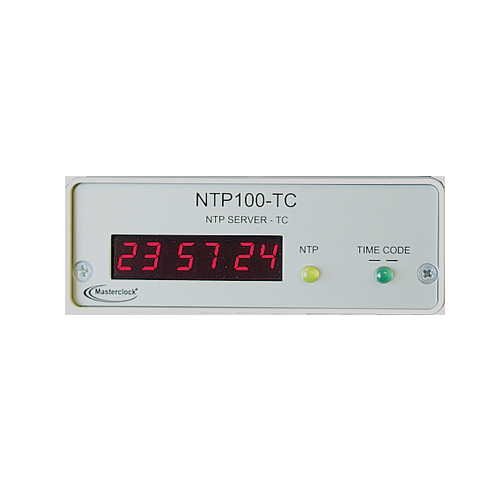
The Masterclock NTP100-TC is a compact NTP time server that synchronizes to an existing time-code source and distributes accurate network time to NTP clients over Ethernet. It is an ideal solution for organizations that already have an IRIG or SMPTE time-code infrastructure and need to make that timing reference available to IT and networked systems.
The NTP100-TC automatically detects the incoming time-code source and converts the reference into Network Time Protocol (NTP), eliminating the need for a separate GNSS antenna or additional primary timing reference. Its long-term timing accuracy follows that of the connected external time-code source.
The unit supports a wide range of industry-standard time-code formats, including IRIG-A, IRIG-B, IRIG-E and SMPTE time codes, making it particularly suitable for broadcast, media, defense, military, telecommunications and other mission-critical environments.
With NTP output accuracy of approximately ±2 milliseconds, the NTP100-TC can provide NTP through unicast, multicast or broadcast modes. It supports IPv4 and IPv6 networks and offers secure configuration and monitoring through SSH/Telnet, SNMP and Masterclock's WinDiscovery software.
In the event of a loss of the external time-code reference, the NTP100-TC automatically switches to its internal temperature-compensated crystal oscillator (TCXO) for holdover. An optional OCXO provides improved long-term stability for applications requiring enhanced holdover performance.
Key Features
Applications
The NTP100-TC is particularly useful where an organization already has a centralized time-code source and needs to distribute that same reference to networked equipment.
Typical applications include:
Why Choose NTP100-TC?
If your facility already distributes IRIG-B, SMPTE or another supported time-code reference, the NTP100-TC provides a simple way to extend that timing reference to Ethernet-connected systems.
Instead of installing a separate GNSS-based NTP server, the NTP100-TC uses your existing time-code infrastructure and converts it into NTP, providing a practical bridge between traditional timing systems and modern IP networks.